


More Exciting Books for Christmas Reading
- Dec 16, 2025
- 7 min read



Compiled by Jamie H. Vaught
Are you still looking or shopping for a nice Christmas gift? Here’s another list of recently-published books that you may want to consider as a special gift for a loved one or a friend.
--The American Revolution: An Intimate History by Geoffrey C. Ward (Alfred A. Knopf, $80) is a richly illustrated, human-centered history of America’s founding struggle — expanding on the landmark, six-part PBS series which began airing in November. In defeating the British Empire and giving birth to a new nation, the American Revolution turned the world upside down. Thirteen colonies on the Atlantic coast rose in rebellion, won their independence, and established a new form of government that radically reshaped the continent and inspired independence movements and democratic reforms around the globe. The American Revolution was at once a war for independence, a civil war, and a world war, fought by neighbors on American farms and between global powers an ocean or more away. In this impressive volume which includes array of prints, drawings, paintings, texts, and pamphlets from the time period, the author ably steers us through the international forces at play, telling the story not from the top down but from the bottom up —and through the eyes of not only our “Founding Fathers” but also those of ordinary soldiers, as well as underrepresented populations such as women, African Americans, Native Americans, and American Loyalists, asking who exactly was entitled to life, liberty, and the pursuit of happiness.
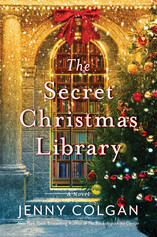
--The Secret Christmas Library by Jenny Colgan (William Morrow Paperbacks, $18.99) is a holiday story filled with mystery with a hint of romance in the Scottish Highlands. Mirren Sutherland stumbled into a career as an antiquarian book hunter after finding a priceless antique book in her great aunt’s attic. Now, as Christmas approaches, she’s been hired by Jamie McKinnon, the surprisingly young and handsome laird of a Highland clan whose ancestral holdings include a vast crumbling castle. Family lore suggests that the McKinnon family’s collection includes a rare book so valuable that it could save the entire estate — if they only knew where it was. Jamie needs Mirren to help him track down this treasure, which he believes is hidden in his own home. But on the train to the Highlands, Mirren runs into rival book hunter Theo Palliser, and instantly knows that it’s not a chance meeting. She’s all too familiar with Theo’s good looks and smooth talk, and his uncanny ability to appear whenever there’s a treasure that needs locating. Almost as soon as Mirren and Theo arrive at the castle, a deep snow blankets the Highlands, cutting off the outside world. Stuck inside, the three of them plot their search as the wind whistles outside. Mirren knows that Jamie’s grandfather, the castle’s most recent laird, had been a book collector, a hoarder, and a great lover of treasure hunts. Now they must unpuzzle his clues, discovering the secrets of the house — forming and breaking alliances in a race against time.
--Unfettered by John Fetterman (Crown, $32) is a candid memoir written by U.S. Senator who shares the story of his journey in public service (which started by winning his first election by a single vote in 2005), including unvarnished details of his life-threatening stroke and lifelong struggles with depression, the truth about what really happens in Washington, and his vision for navigating our divided country’s future. In his early 20s, Fetterman seemed to be set for life. He had an MBA, a job in the risk management industry, and a comfortable future ahead of him. Yet something felt missing, insufficient, lacking in purpose. Having paired with Big Brothers and Big Sisters after a close friend’s tragic death, Fetterman decided to make a change and devote his life to public service instead — first in AmeriCorps, then as the mayor of Braddock, Pennsylvania, later as the state’s lieutenant governor, and now as its senior senator.
--A Short History of Nearly Everything 2.0 by Bill Bryson (Doubleday, $34) is a revised and updated edition of the best-selling popular science book of the 21st century. The author makes complex subjects clear and compelling for everyone with an interest in the world around them. The 550-page book is the result of his quest to understand everything that has happened from the Big Bang to the rise of civilization – how we got from being nothing at all to what we are today. Now fully updated to reflect the many scientific discoveries in the last 20 years since this book was first published, it explains among much else:
why Pluto is no longer a planet
how the number of moons in the solar system has more than doubled in 20 years
how scientists used advances in genetics to discover previously unknown species of early humans
why we still don't know what most of the universe is made of
how the little Higgs boson transformed physics
This journey through time and space will inform a new generation of readers, young and old, as well as those who read this book on first publication with a new perspective based on what we know now. Written in his unique style, Bryson makes complex subjects fascinating and accessible to everyone with an interest in the world around them.
--Independent: A Look Inside a Broken White House, Outside the Party Lines by Karine Jean-Pierre (Legacy LIT, $30) discusses why Americans must step beyond party lines to embrace life as Independents in a nation that is obsessed with blind loyalty to a two-party democratic system. A former White House press secretary in the Biden Administration, the author didn’t come to her decision to be an Independent lightly. She takes us through the three weeks that led to Biden’s abandonment of his bid for a second term and the betrayal by the Democratic Party that led to his decision. She urges Americans to think outside of the blue-and-red box as we consider what’s next to save our democracy.
--The Fate of the Generals: MacArthur, Wainwright, and the Epic Battle for the Philippines by Jonathan Horn (Scribner, $30.99) brings together the story of two men who received the same medal -- their country’s highest military award, the Medal of Honor -- but found honor on very different paths. Douglas MacArthur’s journey would require a daring escape with his wife and young child to Australia and then years of fighting over thousands of miles to make it back to the Philippines, where he would fulfill his famous vow only to see the city he called home burn. Jonathan Mayhew Wainwright’s journey would take him from the Philippines to Taiwan and Manchuria as his captors tortured him in prisons and left him to wonder whether his countrymen would ever understand the choice he had made to surrender for the sake of his men. Based on meticulous research into diaries and letters including boxes of previously unexplored papers, the book is a vivid account that raises timely questions about how we define honor and how we choose our heroes, and is destined to become a classic of World War II history.
--Listening to the Law: Reflections on the Court and Constitution by Amy Coney Barrett (Sentinel, $32) discusses her journey to the Supreme Court and an account of her approach to the Constitution. Since her confirmation hearing, Americans have peppered Justice Barrett with questions. How has she adjusted to the Court? What is it like to be a Supreme Court justice with school-age children? Do the justices get along? What does her normal day look like? How does the Court get its cases? How does it decide them? How does she decide? In her book, the former law professor answers these questions and more. She lays out her role (and daily life) as a justice, touching on everything from her deliberation process to dealing with media scrutiny. Whether sharing stories of clerking for Justice Scalia or walking readers through prominent cases, she invites readers to wrestle with originalism and to embrace the rich heritage of our Constitution.
--A Revolution of Common Sense: How Donald Trump Stormed Washington and Fought for Western Civilization by Scott Jennings (William Morrow, $32) is an inside look at how President Donald Trump has re-taken Washington by storm in his historic second term, written with the participation of the President and his inner circle. From the Oval Office to Air Force One, and from his unique perch as the most popular conservative commentator at CNN, Jennings provides a revelatory look at the dramatic return of Trump to the White House and his efforts to restore common sense to U.S. government and save Western Civilization in the process.
--Leo XIV: The New Pope and Catholic Reform by Christopher R. Altieri (Bloomsbury Continuum, $28) is a biography along with a critical examination of the state of the Church, exploring Robert Prevost's life and work, from his early years in Chicago to his ministry in Peru, and how he came to be chosen as leader of the world's 1.4 billion Catholics. The author provides insight into the politics of the 2025 conclave, alongside Pope Leo's choice of papal name, and the major challenges and deep-rooted problems of the Church that he now must run – and all at a time when the world is asking big questions about what it means to be human in a complex ethical world of AI and global conflict.
--The Most Awful Responsibility: Truman and the Secret Struggle for Control of the Atomic Age by nuclear historian Alex Wellerstein (Harper, $32) makes a startling case that Harry Truman was possibly the most anti-nuclear American president of the 20th century, but his ambitions were strongly constrained by the domestic and international politics of the postwar world and the early Cold War. President Truman’s choice to drop the atomic bomb is the most debated decision in the 20th Century. But what if Truman’s actual decision wasn’t what everyone thinks it was? The conventional narrative is that American leaders had a choice: Invade Japan, which would have cost millions of Allied and Japanese lives, or instead, use the atom bomb in the hope of convincing Japan to surrender. Truman, the story goes, carefully weighed the pros and cons before deciding that the atomic bomb would be used against Japanese cities, as the lesser of two evils. The book is a must-read for all who want to truly understand not only why the bomb was dropped on Japan but also why it has not been used since.


Comments